The Follow-Up Problem Every Insurance Agent Faces
You've invested in leads. You've made the first call, sent the first email. And then... silence. The prospect hasn't responded, and now you're faced with a familiar dilemma: do you follow up again and risk coming across as pushy, or do you let it go and watch your lead investment evaporate?
This tension is one of the most common challenges in insurance sales — and it's almost entirely based on a false premise. The agents who follow up persistently aren't being pushy. They're being professional. The prospects who don't respond to the first outreach aren't saying no — they're busy, distracted, or simply not ready yet. Consistent, value-driven follow-up is how you stay top-of-mind until the timing is right.
"Most insurance sales don't happen on the first call, the second call, or even the third. The agents who win are the ones still in the conversation on the fifth and sixth contact — when most of their competitors have already given up." — Lead2Client CRM Team
The Data Behind Follow-Up
The case for persistent follow-up isn't just anecdotal — it's backed by consistent research across the sales industry.
Sources: Marketing Donut, InsideSales.com Research
The math is striking: 80% of sales require five or more follow-up contacts, yet 44% of salespeople give up after just one attempt. This means the majority of agents are abandoning the majority of their leads before the sale was ever possible. The agents who follow up consistently aren't just being persistent — they're harvesting the leads their competitors left behind.
The Speed-to-Lead Imperative
Before we talk about follow-up sequences, we need to talk about the first contact. Research from InsideSales.com and MIT found that responding to a lead within 5 minutes makes you 21 times more likely to qualify them than responding after 30 minutes. After an hour, your odds of ever reaching that prospect drop by over 80%.
For insurance agents, this means the first follow-up isn't really a follow-up at all — it's the initial response, and it needs to happen automatically, immediately, regardless of whether you're available to make a call.
Set up an automated SMS that fires within 60 seconds of a new lead arriving — even at midnight. Something like: "Hi [Name], I saw you were looking into life insurance coverage. I'm [Agent] and I'd love to help. When's a good time to chat? — [Agency Name]" This single automation can double your contact rate.
Building a Follow-Up Sequence That Converts
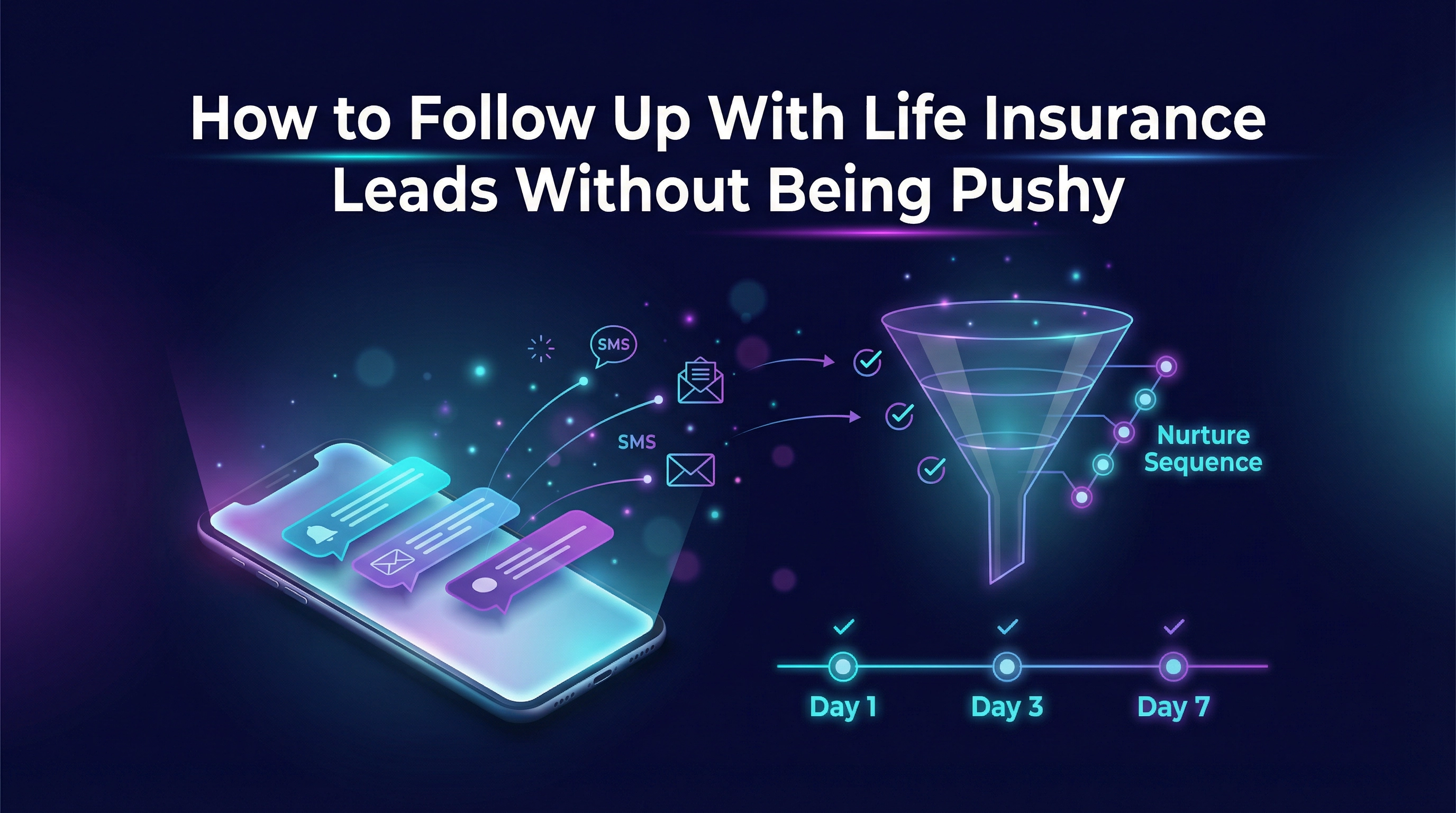
A follow-up sequence is a pre-planned series of touchpoints across multiple channels, triggered at specific intervals after a lead comes in. Here's a framework that works for life insurance leads:
Day 1: The Triple Touch
The moment a new lead arrives: send an automated SMS, send an automated email, and make a personal call attempt. If you don't reach them, leave a brief, friendly voicemail. The goal is to establish contact and demonstrate responsiveness.
Day 2: The Second Attempt
A second call attempt, ideally at a different time of day than your Day 1 attempt. If you called at 10am yesterday, try 4pm today. Include a brief SMS check-in if you don't reach them by phone.
Day 3: The Value Email
Send an educational email that provides genuine value — not a sales pitch. Something like "5 Things Most People Get Wrong About Life Insurance" or "How Much Life Insurance Do You Actually Need?" This positions you as a helpful resource and keeps you top-of-mind without pressure.
"The best follow-up emails don't ask for anything. They give something — a useful insight, a helpful tool, a piece of information the prospect didn't have before. That's what builds trust." — Sales Best Practice
Day 5: The SMS Check-In
A brief, conversational text: "Hi [Name], just checking in — did you have a chance to think about your life insurance options? Happy to answer any questions, no pressure at all." The casual tone and explicit "no pressure" framing reduces resistance significantly.
Day 7: The Final Intensive Attempt
A final call attempt with a voicemail drop, followed by an email that acknowledges you've tried to connect and makes it easy for them to reach you when they're ready. This is your last intensive touchpoint before transitioning to long-term nurture.
Day 14 and Beyond: Long-Term Nurture
Not every lead is ready to buy right now. Life circumstances change — a new baby, a job change, a health scare — and the prospect who wasn't interested in January might be your best client in June. A monthly nurture email with genuinely useful content keeps you top-of-mind without being intrusive.
Monthly newsletter topics that perform well for life insurance nurture: "How Your Life Insurance Needs Change as Your Family Grows," "The Difference Between Term and Whole Life Insurance," "Why Employer-Provided Life Insurance Isn't Enough," and "How to Review Your Life Insurance Coverage Annually."
The Channel Mix That Works
Different prospects respond to different channels. Some people hate phone calls but respond immediately to texts. Others ignore texts but open every email. A multi-channel follow-up sequence maximizes your chances of connecting with each prospect through their preferred channel.
For life insurance leads, the most effective channel mix is typically:
- SMS: Best for initial contact and quick check-ins. 98% open rate, 90-second average response time.
- Email: Best for educational content, detailed information, and long-term nurture. Allows for richer content and easy reference.
- Phone: Best for building rapport and closing. Personal calls convert at higher rates than any digital channel — but only when you actually reach someone.
- Voicemail drops: A pre-recorded voicemail delivered directly to the prospect's voicemail without ringing their phone. Effective for maintaining presence without interrupting their day.
Personalization: The Difference Between Follow-Up and Spam
The line between persistent follow-up and spam is personalization. Generic messages — "Just checking in!" — feel like spam because they are spam. Personalized messages that reference the prospect's specific situation, use their name, and acknowledge the context of your previous interactions feel like genuine human communication.
According to McKinsey research, personalization at scale can deliver 5–8x ROI on marketing spend and lift sales by 10% or more. For insurance agents, personalization means using your CRM to automatically insert the prospect's name, the product they inquired about, their location, and other relevant details into every automated message.
When to Stop Following Up
Persistent follow-up has limits. If a prospect explicitly asks you to stop contacting them, you must honor that request immediately — both for ethical reasons and legal compliance under the TCPA. Your CRM should have a clear opt-out mechanism that immediately stops all automated communications.
For prospects who haven't opted out but simply haven't responded after your full sequence, transition them to a low-frequency long-term nurture program rather than continuing intensive outreach. Monthly contact is appropriate; weekly contact for a prospect who's been unresponsive for 30 days is not.
Lead2Client CRM includes pre-built life insurance follow-up sequences that automatically combine SMS, email, voicemail drops, and long-term nurture — triggered the moment a new lead arrives. Set it up once and convert more leads without lifting a finger.